Wristbands vs Badges vs Keycards for Event Access Control
Managing access control is one of the most important operational decisions for any event. Whether you are running a festival, conference, corporate event, or multi day activation, the way attendees and staff enter spaces directly affects security, speed, and overall experience.
Wristbands, badges, and keycards are the three most common credential types used for access control. While they can overlap in functionality, each serves a very different purpose. Choosing the right option depends on your event format, crowd size, environment, and security needs.
This guide breaks down how wristbands, badges, and keycards compare for event access control and how to choose the right solution for your event.
How do wristbands, badges, and keycards compare for event access control?
At a high level, wristbands and badges are the most popular and practical options for event access control. They are designed for temporary use, high volume entry, and visual identification. Keycards, on the other hand, are primarily used in hospitality environments like hotels and resorts where guests need repeated access to fixed doors.
Wristbands focus on speed and transfer resistance. Badges focus on role visibility and controlled access. Keycards focus on integration with door locking systems rather than crowd flow.
Side by Side Comparison of Access Control Options
Wristbands
- Best for festivals, concerts, multi day events, and large crowds
- Very fast entry and easy visual checks
- High resistance to sharing or transfer
- Durable and weather resistant
- Supports RFID, NFC, QR, or visual only access
- Typically single use or event specific
Badges
- Best for conferences, staff, vendors, media, and VIPs
- Clear role identification at a glance
- Moderate entry speed compared to wristbands
- Can be shared if not paired with checks
- Supports QR codes, barcodes, and RFID
- Ideal for structured environments
Keycards
- Best for hotels, resorts, and venues with fixed doors
- Designed for repeated door access
- Not ideal for crowd entry or scanning lines
- Limited visual identification
- Typically reusable
- Requires compatible door hardware
When Wristbands Make the Most Sense
Wristbands are the most common access control solution for live events with high attendance.
They work especially well for:
- Festivals and concerts
- Multi day events
- Outdoor or weather exposed environments
- Events with multiple entry points
- Situations where speed matters
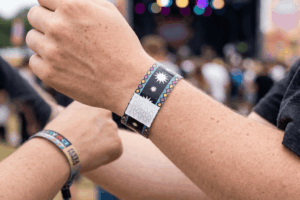
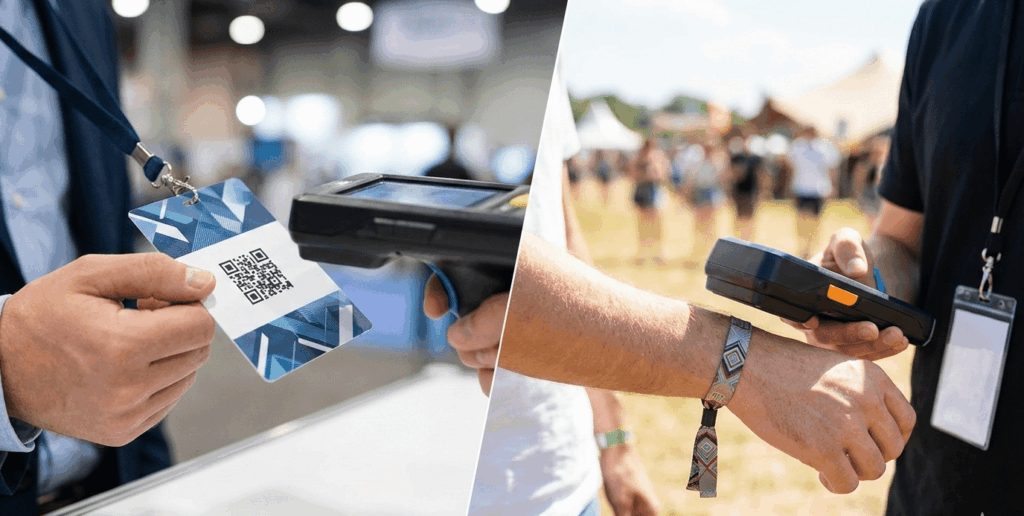
Because wristbands are worn, they are difficult to share and easy for staff to visually verify. When paired with RFID or QR technology, wristbands also allow for controlled entry, zone access, and real time validation without slowing down lines.
When Badges Are the Better Choice
Badges are ideal when role visibility and credential clarity are important.
They are commonly used for:
- Conferences and trade shows
- Corporate and internal events
- Staff, vendors, and media access
- Back of house or restricted areas
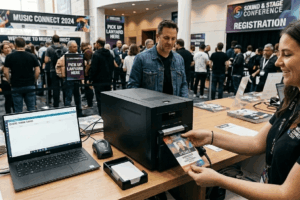
Badges allow event staff to quickly identify who someone is and where they should be. They are especially useful when combined with holders, reels, or color coding. For higher security needs, badges can also include QR codes or RFID chips for controlled scanning.
Where Keycards Fit Best
Keycards are not typically designed for event crowd access.
They are best suited for:
- Hotels and resorts
- Guest room access
- Fixed door systems
- Hospitality environments
While keycards are excellent for room access and controlled indoor spaces, they are not ideal for festivals, conferences, or large scale event entry. They lack visual identification, slow down manual checks, and depend on door hardware rather than staff managed entry points.
For most events, wristbands or badges provide far more flexibility and efficiency.
Customization, Security, and Branding Benefits
Custom wristbands and badges simplify access control by making roles clear at a glance. Colors, labels, and logos help staff move people through entry points quickly while reducing mistakes.
Unique designs, serial numbers, QR codes, or RFID chips also discourage sharing and counterfeiting. Compared to generic credentials, custom options provide better control without adding friction.
In addition, branded credentials elevate the professionalism of an event and extend visibility for organizers and sponsors. Keycards are typically used for functional access in hospitality environments rather than visual identification at events.
Common Hybrid Access Control Setups
Many events use a combination of credentials to balance speed, security, and visibility.
Common setups include:
- Attendees using wristbands while staff and vendors use badges
- RFID wristbands for entry combined with printed badges for identification
- Keycards for hotel rooms paired with wristbands for event access
- Different wristband colors or badge designs for zone based access
Hybrid systems allow event teams to tailor access control to each role without overcomplicating operations.
RFID, QR, or Visual Only: What Should You Use?
The right technology depends on how much control you need.
- Visual only credentials are the fastest and simplest but rely on staff observation.
- QR codes add validation and basic tracking but require line of sight scanning.
- RFID offers the fastest scanning, better durability, and support for zone control and data tracking.
For large or multi day events, RFID wristbands or badges are often the most efficient long term solution.
How to Choose the Right Access Control Method
Ask these questions before deciding:
- How many people will attend?
- Is the event one day or multi day?
- Is it indoor or outdoor?
- Do you need role or zone based access?
- How important is entry speed?
- If planning to use RFID, are you integrating with existing systems?
Answering these will usually make the right option clear.
Final Thoughts
There is no single access control solution that fits every event. Wristbands and badges remain the most practical and widely used options for event access control because they are flexible, efficient, and designed for temporary environments. Keycards play an important role in hospitality settings but are rarely the best choice for live event entry.
Choosing the right credential helps keep lines moving, prevents access issues, and creates a smoother experience for everyone involved.
Frequently Asked Questions
Yes. Wristbands are harder to transfer and easier to verify visually, especially in high traffic environments.
Yes, especially for multi day conferences or events with large attendee counts.
For event access, yes. For hotel room doors, keycards are still the standard.
RFID wristbands provide the fastest entry for large crowds.
Yes. Wristbands and badges can be printed or encoded with role based or zone based access.
Related Posts